
Why Websites Built Faster Still Need Strong Foundations
Websites are evolving structurally and fundamentally in this digital age. And the advent of an AI website builder for small businesses has allowed entities to launch websites in less time. Time-to-launch has become a competitive advantage, especially for startups and growing brands that want to validate ideas quickly.
However, building websites instantly doesn’t mean they are fundamentally strong. Many websites look polished on the surface, with performance lags, security gaps, and scalability issues. The drag-and-drop landing page builder is also an architectural tool that builds websites, which often collapse under real-world traffic and business growth. Hence, this guide suggests that instantly building websites must have a solid foundation.
Should You Build Your Website Faster?
Gaining an edge by validating ideas quicker than your competitors is always a good thing. So yes! You should build your website sooner. It allows for faster campaign launches and quicker market penetration. But remember, speed is an important starting point, not an end goal.
The real goal is to achieve a solid balance between a well-thought-out foundation and a build that can be executed quickly. You can launch quickly as long as your hosting is reliable, your site is secured, and your infrastructure is well-thought-out. A fast build is complemented by thoughtful infrastructure.
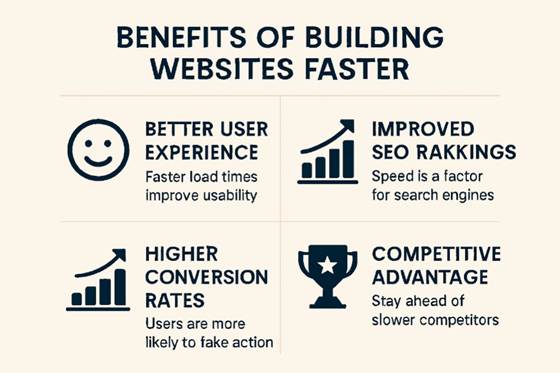
Key Benefits of a Faster Website Build
Reasons for A Stronger Website Foundation
Faster Design Doesn’t Equal Performance Stability
While a design may appear to load quickly, true performance stability can only be achieved through solid resource management, caching, and backend optimization. Weak infrastructure exposes itself through slow load times and errors. Especially when multiple users or increased traffic come to your website.
A strong foundation ensures performance consistency under pressure. Optimized hosting, proper resource allocation, and server-side tuning keep websites responsive amid the initial launch excitement.
Hosting Architecture Defines Long-Term Scalability
Several fast-built websites initiate basic web hosting plans that handle small traffic volumes. As the website grows, these plans struggle to keep up with in-demand resources, leading to downtime or performance lags.
A good website hosting foundation makes it easy to scale. Flexibility to upgrade resources without rebuilding is offered by cloud, VPS, or managed web hosting.
Security is Non-Negotiable
Quick website launches often overlook the basics of risk mitigation, like malware, backups, and hardened servers. Attacks, data leaks, and defacement create major issues within days of going live.
Having a strong foundation includes a built-in security layer protecting the website regularly. Proactive monitoring, regular updates, and intrusion prevention systems ensure the speed doesn’t breach the safety standards.
Scalability Needs Planning from Day One
A website with moderate traffic may perform well, but the problem increases when the traffic spikes. The website slows down, crashes, or fails during traffic surges without a scalable infrastructure.
A strong foundation gives websites the room to scale smoothly. With the proper resource planning, load handling, and flexible hosting architecture, businesses grow without rebuilding the entire website environment.
Reliability Builds User and Search Engine Trust
Website visitors want quick loading times and 100% accessibility. Slow response times and frequent outages damage its credibility and push users to competitors.
Reliable websites are valued by search engines. A solid site building its technical infrastructure improves crawlability, uptime, and performance. It builds faster websites while maintaining its SEO ranking.
Getting Your Setup Right to Simplify Maintenance
Management of enterprise-level sites becomes more difficult with a bad setup and configuration. Backups, updates, and performance tuning become complex.
Maintenance is simplified with good infrastructure. The clean server environment, automated backups, and managed updates reduce the technical debt of a site and keep it more functional.
Summary
In the digital ecosystem, the construction of websites is easier and quicker than before. However, the construction of websites and maintaining a fast structure will not provide a successful and fully functional website without the building of a solid infrastructure. Using a top-tier web hosting plan with an infrastructure that can be scaled, and a safe environment of servers is what allows a website to stay fast, credible, and safe for a long time after it has launched. With good infrastructure, the investment is able to turn high performance into long-term success.
Leave a Reply